
Common Pool/Spa Barrier Faults: No 1 - Gates and Latches
Why Pool Gates Are Now the Biggest Cause of Non‑Compliance
When Victoria first introduced mandatory pool and spa barrier inspections, most homeowners moved quickly to obtain their initial compliance certificate. Fast‑forward four years, and those same pools and spas are now coming up for their follow‑up inspections.
Here’s the interesting pattern emerging:
Most barriers were made compliant four years ago — but many gates no longer are.
The Shift From Barrier Issues to Gate Issues
In the early days, non‑compliance was often about obvious barrier defects: climbable objects, gaps, or incorrect latch heights. Today, the barriers themselves generally hold up well over time.
What doesn’t always hold up is the gate.
Gates are the only moving part of the barrier system. They’re constantly exposed to weather, movement, wear, and the occasional enthusiastic child. Over a few years, even small changes in hinge tension or latch alignment can cause a once‑compliant gate to fail the current regulations.
What the Regulations Actually Require
The standard is very clear about how a pool gate must operate:
“Gates shall be fitted with a self‑closing device that will close the gate from any position, with a stationary start, without the application of a manual force and operate the latch. The self‑closing device shall be capable of complying with these requirements with the gate at any position from fully open to resting on the latch.”
Most people test their gate by opening it wide and letting it go.
And yes — from that position, almost every gate will swing shut with enough momentum to latch.
But that’s not the real test.
The Critical Test: “Resting on the Latch”
The point where most gates fail is when they’re just slightly ajar — the “resting on the latch” position. This is where the gate has almost no momentum, so the hinges and latch must be perfectly aligned and properly tensioned.
If the gate can’t close and latch from this position on its own, it’s non‑compliant.
This is the scenario I see most often during inspections. It’s subtle, but it’s exactly the kind of failure that can compromise safety, especially with young children around.
Adjusting the Latch
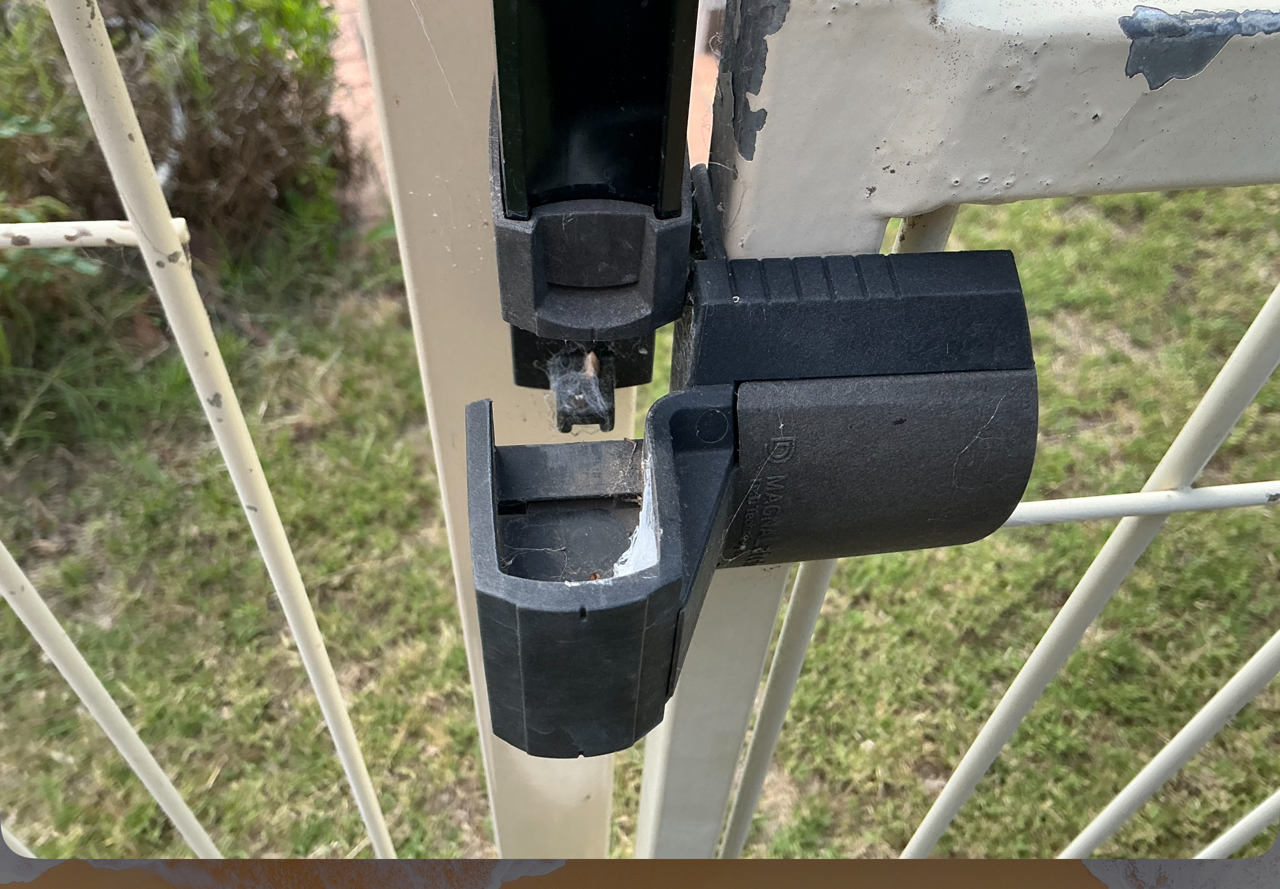
The latch in the photo is commonly used on aluminium pool barriers where the release must be 1.5 m above ground level, it is a great piece of hardware. It includes built‑in horizontal and vertical adjustment, which helps maintain compliance over time.
But even the best latch needs occasional fine‑tuning.
A few millimetres of movement in the gate or posts over several years can be enough to cause a failure.
What Homeowners Can Do
A quick annual check can prevent most gate‑related issues:
Test the gate from every position, not just fully open
Make sure it latches without manual force
Check for sagging, rubbing, or misalignment
Adjust hinge tension as needed
Ensure the latch engages cleanly and consistently
A search online for ‘how to adjust a pool gate latch’ should help you out.
If anything feels “off,” it’s worth addressing before your next inspection.

